Game Theory: Which game is your empoyer playing?
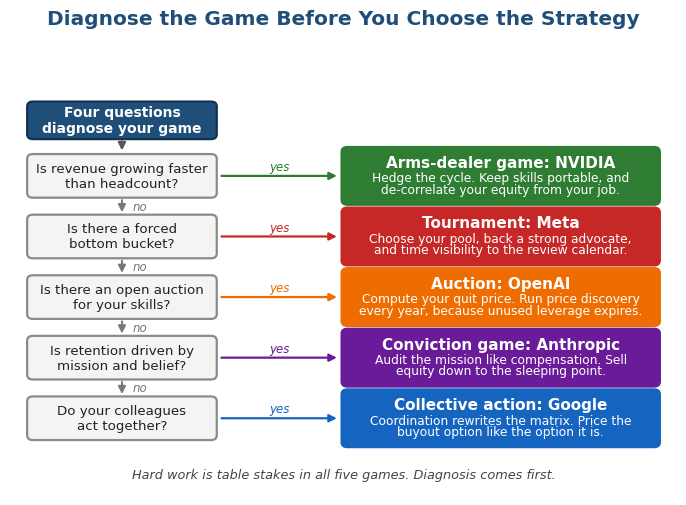
Work hard is not a strategy. Google, Meta, NVIDIA, OpenAI, and Anthropic are playing five different games, and the same effort pays out differently in each one.
If you are a software engineer or a data scientist in 2026, you have probably noticed that the old career advice has stopped working. “Work hard and you will be fine” assumes you are playing a game where effort maps to reward. That game no longer exists at most large tech companies. What exists instead is a set of different games with different rules, and the same hard work produces radically different outcomes depending on which game your employer is playing.
This post uses five companies – Google, Meta, NVIDIA, OpenAI, and Anthropic – as five distinct games. For each one, I lay out the rules, the equilibrium, and the moves that actually protect an employee. The goal is not cynicism. The goal is to give you a correct model of the board you are sitting at, because you cannot pick a good strategy until you know which game you are in.
Meta: The Tournament
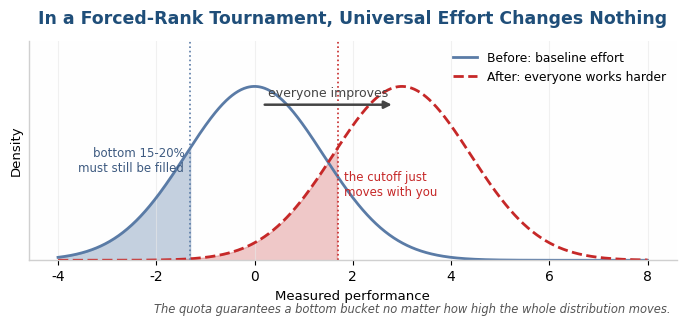
The rules at Meta are now public knowledge. In early 2025 the company cut roughly 5% of its workforce, about 3,600 people, and labeled them low performers, even though reporting later showed that some of those let go had recent ratings of “meets” or “exceeds expectations.” A few months later, an internal memo told managers to place 15% to 20% of employees on teams of 150 or more into the bottom performance bucket, up from 12% to 15% the year before, and described the midyear review process as “an opportunity to make exit decisions.” This is a forced distribution with a quota, and it changes the game completely.
In game theory terms, a forced distribution converts an absolute performance game into a tournament. Economists Lazear and Rosen formalized tournaments decades ago: your payoff depends on your rank relative to your peers, not on your output. Once rank is what matters, the equilibrium is grimly predictable. Everyone increases visible effort, everyone works longer hours, and because the distribution is forced, the rank ordering barely moves. The result is the concert-standing equilibrium: everyone stands, nobody sees better, and everyone is more tired. Hard work cannot save you in this game because the quota guarantees that someone on every large team must be labeled a low performer regardless of how well the whole team performs.
The deeper playbook at Meta starts with identifying the pool you actually compete in. The quota binds inside calibration pools, not across the company, so the single most important strategic variable is which pool you sit in. A uniformly strong team is the most dangerous seat in the building, because the bottom bucket must still be filled from somewhere. A pool tied to revenue-critical systems, where a rushed exit would be politically expensive for the managers running it, is structurally safer. Transferring into the right pool beats working harder in the wrong one, and almost nobody treats pool selection as the strategic decision it is.
Second, recognize that your manager’s bargaining power in calibration is your hidden asset. Calibration meetings are negotiations among managers, and the outcome for your rating depends heavily on how well your manager argues and how much political capital they are willing to spend on you. A strong engineer under a weak advocate loses to a decent engineer under a strong one. When you choose a team, evaluate the manager’s track record of protecting their reports through past cycles, not the tech stack.
Third, time your visibility to the review calendar. Calibration committees can only price what they can see, and wins that land after the cycle opens effectively do not exist. Front-load finished, demo-able, easily summarized outcomes into the six weeks before each review, and avoid signing up for long-horizon invisible infrastructure work in that window, no matter how valuable it is.
Fourth, know when to reset the prior. Ratings are sticky: once you are marked, evaluators update slowly from a hostile prior, and the expected value of “working harder to prove them wrong” is lower than the expected value of transferring to a new pool where the prior resets. People misread internal transfers as defeat; in repeated-game terms, a transfer is the mechanics of reputation repair.
Finally, never let the label land first. If you sense the bottom bucket forming around you, a voluntary exit before the review closes preserves your signal, while a labeled exit damages the outside option that disciplines every future employer. The severance you collect is small compared to the wage discount of arriving on the market with a “low performer” story.
Google: The Collective-Action Game
Google employees face many of the same pressures, including the GRAD review system with its bell-curve-style grading and a steady sequence of quiet cuts, with TechCrunch reporting between 1,500 and 3,000 engineers let go this year alone at a company of more than 190,000 people. What makes Google different is what employees did about it. In July 2026, more than 4,500 Google workers signed a petition delivered to CEO Sundar Pichai demanding guaranteed severance, buyout offers before forced layoffs, the option to take severance as extended paid leave to protect healthcare and visa status, and an end to quota-driven performance ratings.
Here is the part that matters for game theory. Collective action is a classic prisoner’s dilemma: the benefits of organizing are shared by everyone, while the costs and risks fall on the individuals who participate, so free-riding is the dominant strategy and rational employees never organize. Google is the documented counterexample. The Alphabet Workers Union reports that voluntary exit packages have now been offered to more than 70,000 employees, and Pichai himself said the program came from listening to employees because “it gives people agency.” A buyout offered before a forced layoff is not a small perk. In payoff terms, it converts the worst cell of the matrix, sudden termination, into a voluntary option with positive value. It is the only case in this industry where employee action measurably changed the payoff matrix rather than merely playing harder inside it.
The deeper lesson is about where your effort has marginal value. At a company of 190,000 people, an extra hour of individual work has essentially zero effect on your job security, because your security is determined by the matrix, not by your output. But the same hour spent on coordination – signing, showing up, recruiting two colleagues – has a nonzero probability of rewriting the matrix itself. The expected value calculation is not even close, and engineers who would never misallocate compute resources misallocate their own effort constantly.
There is also a concrete arbitrage sitting inside the voluntary exit program that most people never price. A buyout is an option, and the rational decision rule is to accept it when the package plus your expected re-employment speed exceeds the value of staying net of your personal layoff risk. Engineers systematically under-exercise this option because of status quo bias and because the package feels like an admission of failure. It is not. If your outside option is strong, a voluntary package is the company paying you to do what you should have done anyway. For visa holders, the demand for severance-as-paid-leave deserves special attention, because it converts a catastrophic cliff into a search window, and that single term can be worth more than a level promotion.
NVIDIA: The Arms Dealer’s Game
NVIDIA plays a different game entirely. In January 2023, while Meta cut 11,000 people, Amazon cut 18,000, and Google cut 12,000, Jensen Huang told his employees there would be no layoffs, and the company hired aggressively instead. Voluntary turnover fell to 2.7% in fiscal 2024, roughly one-fifth of the tech sector average, while headcount grew from about 19,000 to more than 36,000. The organization runs unusually flat, with Huang holding 40 to 60 direct reports and information flowing horizontally rather than up through filters.
The game theory here is about which side of the arms race you sit on. NVIDIA sells the weapons in the AI arms race, which means its revenue grows precisely when everyone else’s fear grows. Employees of an arms dealer play a positive-sum game: when the pie grows faster than headcount, the firm has no need for tournaments, quotas, or forced distributions, because there is no scarcity to allocate. Cooperation is stable not because NVIDIA is nicer but because growth makes defection unnecessary.
But the equilibrium is conditional, and the deeper playbook at NVIDIA is mostly about managing that condition. The first problem is correlation. Your salary, your bonus, your equity, and your job security are all long the same asset, which is the AI capital-expenditure cycle. Your human capital and your financial capital fail in the same week if the cycle turns, and that is precisely the failure mode that wiped out Enron employees. The hedges are unglamorous: keep your skills portable, meaning systems-level machine learning that transfers across employers, rather than letting your expertise become firm-specific tooling mastery that raises your internal value while lowering your external liquidity; and diversify vested equity out of the single position instead of letting one ticker become your entire net worth.
The second problem is that your real performance review is not your performance review. It is the hyperscalers’ capex guidance, because that number is the demand curve for your employer’s product. Watch it the way a portfolio manager would, and calibrate your personal risk-taking – a mortgage, a sabbatical, a startup leap – against it rather than against your last rating. Third, the flat structure changes the internal game. When one executive has 40 to 60 direct reports, managing up is nearly impossible, and the currency that matters is horizontal reputation: how many people across the organization have directly experienced your work. Build a wide internal network, because when consolidation eventually comes, the people who survive are the ones whose value is common knowledge rather than privately held by one manager.
OpenAI: The Auction
OpenAI is where the employee bargaining game became most visible. In 2025, Meta raided the lab so aggressively that Sam Altman publicly claimed signing bonuses as high as $100 million were being offered to his researchers, and roughly 50 researchers were approached. Chief research officer Mark Chen wrote in an internal memo that he felt “a visceral feeling right now, as if someone has broken into our home,” and the company responded by recalibrating compensation, handing out retention grants reported around $1.5 million to roughly a thousand employees and up to $5 million for the most sought-after researchers, and even shutting the company down for a week so exhausted staff could recover. SignalFire’s data puts OpenAI’s two-year retention at 67%, the weakest of the major labs, which tells you the auction is still open.
Before the raid, OpenAI was close to a monopsony: if you wanted to work at the frontier, your outside options were limited, and the firm captured most of the surplus. The raid converted the relationship into an open auction, and in an auction your price is set by your best outside option, not by your effort or your loyalty. The deeper playbook starts with computing your quit price. Divide your unvested equity by your remaining vesting years, and the result is the implicit annual retention payment your employer believes is necessary to keep you. Any outside offer below your current cash plus that number is a pay cut, no matter how impressive the title, and any offer above it is a raise you have not priced. Most employees have never done this arithmetic, which means they negotiate against themselves.
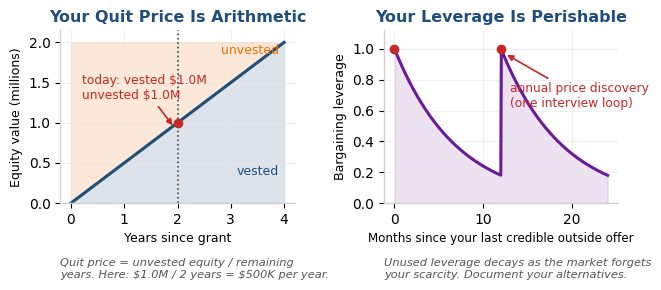
Second, treat leverage as a perishable good. In an auction, your bargaining power is only real at the moment a credible outside offer exists, and unused leverage depreciates as the market’s perception of scarcity shifts. Run price discovery once a year by interviewing at the credible rival even when you are happy, because the point is not leaving; the point is keeping your threat point honest. Your employer’s generosity is a function of your documented alternatives, and an undocumented alternative does not exist.
Third, read the grant design for what it reveals. A retention grant pays you to stay while raising the cost of leaving, which means the firm is buying down your future leverage with today’s money. Roughly a thousand employees received grants, which is the firm telling you exactly where it believes the scarce layer sits. If you are inside the layer, your leverage is the strongest in the industry and you should price it. If you are outside it, your strategy is different: either make yourself legible to the scarce layer by shipping work that the scarce layer depends on, or take your skills to a market where you are the scarce layer. Fourth, handle the private equity like a professional. Your equity is paper until a tender converts it to cash, so learn the lock-up terms, the eligibility windows, and the tax treatment before you need the money, and treat the week-long shutdown as a data point about the intensity that the compensation is actually paying for.
Anthropic: The Conviction Game
Anthropic is the most instructive case because it won the talent war while refusing to fight it. The lab declined to match Meta’s nine-figure offers, with CEO Dario Amodei insisting on internal fairness principles, and yet SignalFire reports the highest two-year retention of any frontier lab at 80%, with engineers about eight times more likely to move from OpenAI to Anthropic than in the reverse direction and 88% of technical offers accepted. The valuation climbed from $61.5 billion in March 2025 to $183 billion that September and past $350 billion by early 2026. Most revealing of all, when the company organized an employee tender offer at the $350 billion valuation, it came in undersubscribed: given a rare chance to turn paper into cash, many employees declined to sell because they believed the shares would be worth more later.
Anthropic plays a repeated game in which the currency is credibility. Mission and internal fairness act as commitment devices: they make the firm’s future behavior predictable, and predictable fairness lowers the wage premium needed to retain people. The undersubscribed tender is the employees’ revealed preference, and it means they are holding their equity the way investors hold a position when they believe they have private information about future value. This is a genuinely different equilibrium from OpenAI’s auction. At OpenAI, you stay because leaving is expensive. At Anthropic, you stay because you believe.
The deeper playbook here is about auditing belief with the same rigor you would apply to any other asset. First, treat mission as compensation, because it is. You accept less cash, or decline outside offers, in exchange for meaning, which means the day the mission drifts, your real wage just fell and the discount you granted must be re-priced. Run the audit quarterly: compare the public commitments against the actual deployment decisions, and notice the gap before it notices you.
Second, check your tender behavior against the endowment effect. People hold employer equity because selling feels like disloyalty, but an investor would call the same position dangerous concentration. A workable rule is to sell to the sleeping point: sell enough of the position that the remainder no longer affects your sleep, then hold the rest on an explicit thesis you can write down in two sentences. Third, and most subtle, recognize that conviction erodes your threat point from the inside. The same belief that keeps you from selling your equity also keeps you from interviewing, maintaining your network, and tracking your market value. The failure mode of the conviction game is discovering that your outside option atrophied on exactly the day the mission cracks. Keep one foot in the external market especially when you believe, because belief is when you least feel the need.
The Five Games at a Glance
| Company | Game | What the firm optimizes | What actually protects you |
|---|---|---|---|
| Meta | Forced-rank tournament | Continuous exits without layoff headlines | Pool selection, manager advocacy, and timing |
| Collective action | Quiet restructuring | Coordination, plus pricing the buyout option correctly | |
| NVIDIA | Arms dealer | Capturing the AI capex cycle | De-correlating your human and financial capital |
| OpenAI | Auction | Locking the scarce layer | Quit-price arithmetic and annual price discovery |
| Anthropic | Conviction | Retention through mission credibility | Auditing the mission and the equity position like an investor |
Eight Moves That Actually Change Your Payoff
Working hard is table stakes everywhere and a differentiator nowhere, because your colleagues are working hard too. The moves below change the structure of what you get paid for.
Choose your pool, not just your team. In any forced-rank system the quota binds inside a calibration pool, so the most consequential career decision is which pool you sit in. Pools attached to revenue-critical systems, where removing a person is politically expensive, are structurally safer than uniformly brilliant teams that still must fill a bottom bucket.
Choose advocates, not managers. Calibration is a negotiation among managers, so your manager’s stock of political capital and willingness to spend it on you is an invisible component of your compensation. Evaluate a manager’s track record of protecting reports through past cycles the way you would evaluate a lawyer.
Time your visible output to the review calendar. Committees can only price what is in front of them. Finished, demo-able outcomes that land in the six weeks before a review cycle are worth more than better work that lands after it, so front-load legible wins and refuse to start invisible infrastructure projects inside that window.
Reset bad priors by changing games. Ratings are Bayesian priors with slow updating. Once you are marked, improvement under the same evaluators has low expected value, while a transfer resets the prior entirely. Internal mobility is not retreat; it is the mechanics of reputation repair.
Compute your quit price before you negotiate. Unvested equity divided by remaining vesting years is the implicit retention payment in your current package. Any outside offer below current cash plus that number is a pay cut regardless of title, and any offer above it is a raise you have not priced.
Keep your threat point honest. Your employer’s generosity is a function of your documented alternatives. Interview once a year even when you are happy, because the point is price discovery, not departure, and an alternative you cannot document does not exist in the negotiation.
De-correlate your risks. When salary, equity, job security, and professional network all hang on one company, your human capital and financial capital fail in the same week. Portable skills and diversified vested equity are the hedge, and the hedge feels unnecessary exactly until the week it is not.
Audit belief like an investor. Mission is compensation, so when the mission drifts your real wage just fell. Write down the thesis for holding your equity in two sentences, sell enough that the remainder does not affect your sleep, and remember that conviction quietly erodes the outside options you will need if the belief ever cracks.
The One Move That Works in Every Game
Each of the five games has its own optimal play, but they share a meta-strategy: preserve your ability to switch games. Skills that transfer between employers, savings that buy you months of search time, and a network that answers your emails are worth more than any single company’s opinion of you. In game theory, the value of a strategy is the value of the options it keeps open. Work hard, by all means – but work hard at keeping your options open, because that is the only equilibrium that holds in all five games at once.